Penny test vs quarter test for tires: what each coin shows
By Tread AI team. Updated November 8, 2026
Push a penny head-first into a tread groove. If you can see space above Lincoln's head, the tread is under 2/32″ (1.6 mm), the legal minimum in most states, and the tire needs replacing now. A quarter is the better check: Washington's head marks 4/32″ (3.2 mm), where Consumer Reports says to start shopping and Tire Rack says to replace tires if you drive in rain.
| Coin result | Tread depth | What to do |
|---|---|---|
| Space above both heads | Under 2/32″ (1.6 mm) | Replace now. Below the legal minimum in most states. |
| Lincoln's head just touching; space above Washington's | About 2/32″ (1.6 mm) | Replace now. The tread is level with the wear bars. |
| Lincoln's head covered; space above Washington's | 2/32″–4/32″ (1.6–3.2 mm) | Replace soon, before the next rainy stretch. Wet braking is already much longer. |
| Washington's head just touching | About 4/32″ (3.2 mm) | Start shopping. Replace before winter or the rainy season. |
| Both heads covered | More than 4/32″ (3.2 mm) | OK for rain. For snow you need about 6/32″ (4.8 mm), and only a gauge can tell you that. |
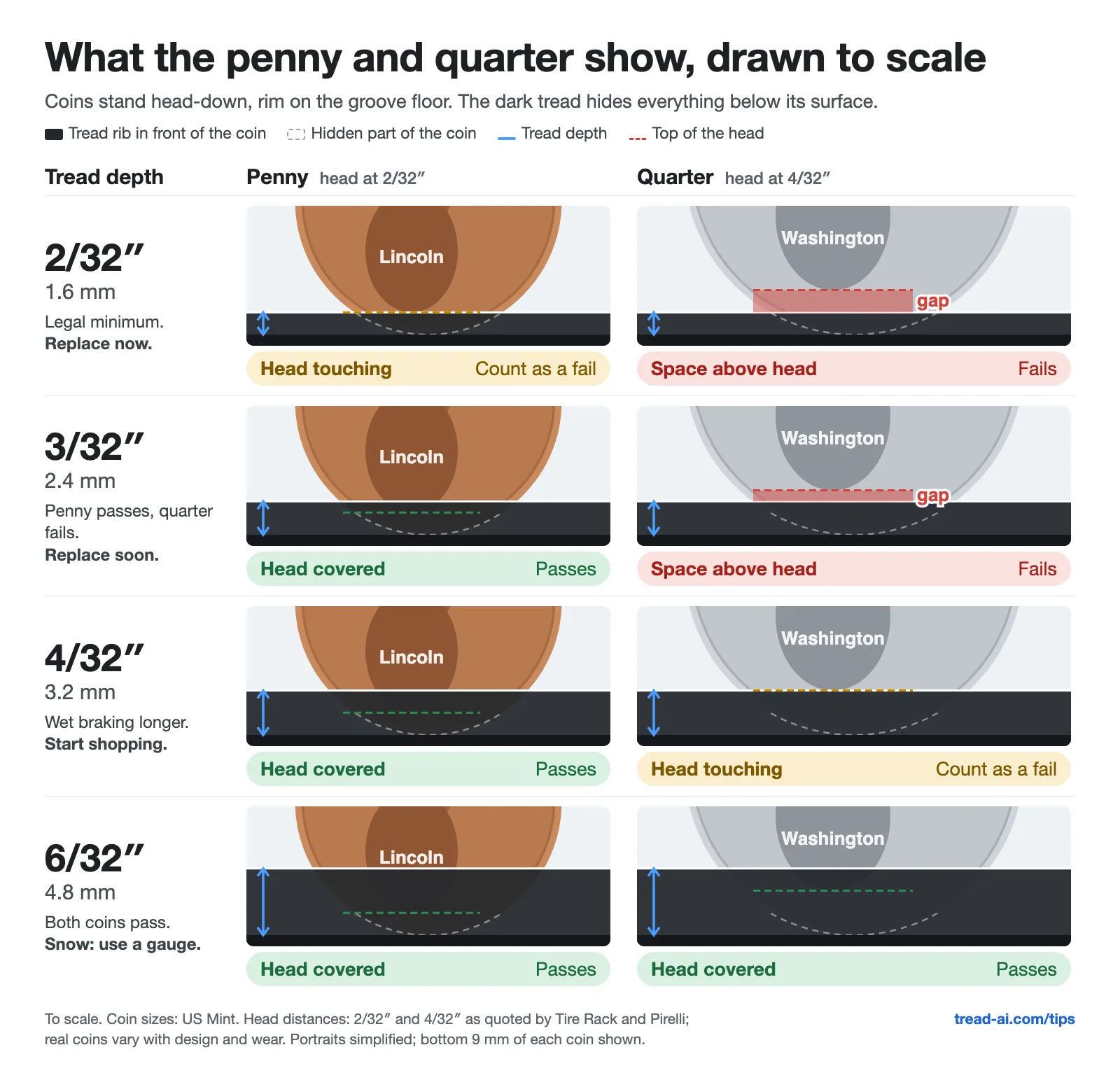
How do you do the penny test on tires?
Stand a penny upside down in a main groove and look at the top of Lincoln's head. If the tread covers it, you have more than 2/32″ (1.6 mm). If there's space above it, you're below that and the tire should come off. NHTSA describes the same check and says tires are not safe and should be replaced at 2/32″. Doing it right takes a minute per tire:
- Pick a main groove, one of the deep channels that run all the way around the tire. Skip the thin slits in the tread blocks and the shallow grooves on the shoulder.
- Hold the penny with Lincoln's head pointing down into the groove and his face toward you.
- Push it straight in until the rim rests on the bottom of the groove. Keep it upright, not tilted, and away from the raised wear bars that run across the groove.
- Look at the top of his head. Covered by tread: more than 2/32″. Touching the tread or any space above it: at or below 2/32″.
- Repeat in the inner, center and outer grooves, and at a few spots around the tire. Pirelli's rule is simple: if any point fails, get new tires. Then do the other three.
The quarter test works exactly the same way with Washington's head, and its line sits at 4/32″ (3.2 mm). Do both: the penny tells you whether the tire is legal, and the quarter tells you whether it still has the depth to clear water.
Penny test vs quarter test: which coin should you use?
Use the quarter. A penny only tells you when the tire is already worn out, and by then wet braking is far worse than on a new tire. AAA recommends the quarter over the penny because tires that fail the penny test are already considered unsafe. Consumer Reports tells drivers to start shopping when Washington's head is flush with the tread, and Tire Rack advises replacing at about 4/32″ if you drive in rain.
| Tread depth | Distance to stop | Still moving at | Which coin catches it |
|---|---|---|---|
| New, 11/32″ (8.7 mm) | 205 ft | 0 mph (stopped) | Neither, both heads covered |
| 4/32″ (3.2 mm) | 270 ft | 35 mph | Quarter |
| 2/32″ (1.6 mm) | 400 ft | 50 mph | Penny and quarter |
"Still moving at" is the speed each car was doing at the point where the car on new tires had already stopped. Tire Rack's light truck stopped in 216, 261 and 287 ft at the same three depths, so the gap was smaller for the heavier vehicle, but the order was the same.
Two other tests point the same way. In Tire Rack's 2007 test from 70 mph, a BMW sedan needed 195 ft on new tires, 290 ft at 4/32″ and 379 ft at 2/32″. In AAA's 2018 test from 60 mph, tires worn to 4/32″ needed 42% more distance to stop on a Toyota Camry and 44% more on a Ford F-150.
The band between the two coins is where the penny misleads people. A tire at 3/32″ (2.4 mm) passes the penny, so it looks fine, yet Tire Rack's depth chart calls 3/32″ "critically low tread, minimal wet traction." If the penny passes and the quarter fails, the tire needs replacing soon, not next year.
A pass on the penny test doesn't mean a tire is safe. It only means the tread is above the legal minimum. If the quarter fails on any groove, plan new tires now, and don't wait for a rainy season to find out what 400 feet of stopping distance feels like.
Is the penny test accurate?
It's accurate enough for the one question it asks, which is whether you have more than about 2/32″, and it can't answer anything else. A coin is a pass/fail line, not a measurement. A tire at 3/32″ and a new one at 10/32″ both cover Lincoln's head, and a tire at 5/32″ and one at 10/32″ both cover Washington's.
The coins also weren't designed as gauges. The 2/32″ and 4/32″ figures are the distances tire makers and testers quote, but the Mint has re-cut both portraits over the years: Lincoln's features were moved further from the edge of the penny in 1969, and Washington's bust was shrunk slightly in 1999 for the state quarters. Coins in your pocket are worn as well. The margin is small, because 1/32″ is 0.79 mm, about half the thickness of a penny (1.52 mm). We haven't found a source that measures the gap on each design, so treat any result that's close to the line as a fail.
Coin readings usually go wrong in one of four ways:
- On a wear bar or a shallow groove. The coin sits high and reads less tread than the tire has, or it sits in a side groove that doesn't reflect the main tread.
- One spot only. Tires rarely wear evenly. An inner edge worn by bad alignment can be at 2/32″ while the center groove still covers Washington's head. The lowest reading on the tire is the one that counts.
- Tilted or propped up. A coin that leans, or rests on a stone in the groove, isn't standing at the height the test assumes.
- The wrong coin. The Mint stopped making pennies for circulation in 2025 and now strikes the cent only for collector sets; older pennies still work. Four of the five 2026 quarters don't show Washington on the heads side at all (Pilgrims, Jefferson, Madison and Lincoln appear instead), so use a quarter dated 2025 or earlier.
What about the Lincoln Memorial on the back of the penny?
Skip it. Some shop and blog pages say the Lincoln Memorial on the back of older pennies marks a deeper line, but they don't agree on where (we found 6/32″ on some pages and 3/32″ on others), and we found no tire maker, test or government page that uses it. Only pennies from 1959 to 2008 show the memorial; since 2010 the back has a shield. If you want to know whether you have 6/32″ for winter, a gauge is the only reliable way.
Penny test vs a tread depth gauge: when is a coin enough?
A coin is enough for a monthly check while Washington's head is clearly covered. Switch to a gauge when the quarter result is close, before winter, or before you buy or sell a car. A coin gives you yes or no at one depth; a gauge gives you the number, so you can tell a tire at 5/32″ that needs replacing before snow from one at 7/32″ that has another season in it. AAA describes gauges as inexpensive and sold at any auto parts store, and many read in both 32nds and millimetres. To use one:
- Set the probe in a main groove, between the tread blocks and not on a wear bar.
- Press the base down until it sits flat on the ribs on both sides of the groove.
- Read the depth on the scale or the screen, then zero or reset the gauge.
- Measure the inner, center and outer grooves at a few spots around the tire, and write down the smallest reading. Pirelli treats that as the tire's depth.
| Check | What it tells you | Weak spot |
|---|---|---|
| Penny | Pass or fail at 2/32″ (1.6 mm), the legal minimum | By the time it fails, wet braking is already far worse |
| Quarter | Pass or fail at 4/32″ (3.2 mm) | Can't tell 5/32″ from 10/32″; most 2026 quarters don't show Washington |
| Wear bars | The tread is flush with the bars at 2/32″ (1.6 mm) | Only tells you the tire is already worn out |
| Tread depth gauge | The actual depth in 32nds, and usually mm | You need to measure several spots and read it carefully |
| Tread AI app | Estimated depth of each tire from a photo, plus tire age and uneven wear | An estimate, about 1.4 mm average difference on real tires; confirm near a limit |
| Tire shop | Measured depth plus a look at damage and wear | You have to go there; Tire Rack notes many shops measure for free |
What a coin can't tell you: snow, age and damage
Snow. Tread for snow needs to be deeper than tread for rain. Tire Rack advises replacing at about 5/32″ if snow is a concern, and its chart says tires start losing snow traction at 6/32″ (4.8 mm). Both coins pass a tire at 5/32″, so for winter, measure with a gauge. Our winter tread depth guide covers the numbers and the BC, Quebec and US mountain-state rules.
Age. Rubber ages even when the tread looks fine. NHTSA notes that some vehicle and tire makers recommend replacing tires that are six to 10 years old regardless of tread. The age is in the last four digits of the DOT code on the sidewall: see how to read a tire DOT code.
Damage and uneven wear. NHTSA says to stop using a tire with cuts, cracks or bulges, or with irregular wear from under-inflation or overloading. A coin in the center groove won't see any of that, so look along both edges and the sidewalls too. Our tread depth chart shows what common wear patterns point to.
Checking all four tires at once
Check tread once a month, when you check pressure, as NHTSA advises. If you'd rather have numbers than a coin result, Tread AI estimates tread depth from a photo of each tire in 32nds or mm, reads the DOT date code and flags uneven wear, and puts all four tires in one report. Its readings are estimates, with about 1.4 mm average difference on real tires, which is nearly the whole gap between the penny line and the quarter line. Near 4/32″, confirm with a gauge or a tire shop.
Questions people ask
- Which way does the penny go in the tire?
- Head first: Lincoln's head points down into the groove and his face is toward you. Push it straight in until the rim rests on the bottom of a main groove, not on a wear bar.
- What if the tread covers only part of Lincoln's head?
- Then the tread is above the top of his head, so you have more than 2/32″ (1.6 mm). That only means the tire is legal. Do the quarter test next to see if you still have 4/32″ (3.2 mm).
- Is 3/32 tread depth safe?
- It's legal in most states, but Tire Rack's depth chart calls 3/32″ (2.4 mm) critically low, with minimal wet traction. A tire at 3/32″ passes the penny test and fails the quarter test. Replace it soon, especially before rain or winter.
- Do the new 2026 quarters work for the quarter test?
- Mostly not. The 2026 semiquincentennial quarters have new designs on the heads side, and only the Revolutionary War quarter shows Washington. Use a quarter dated 2025 or earlier, or better, a tread depth gauge.
- Can I use the penny test on winter tires?
- Not to decide whether they're good for snow. Winter tires start losing snow grip near 6/32″ (4.8 mm), and both coins pass a tire well below that. Use a gauge. See our winter tread depth guide.
- Will a tire shop check my tread depth for free?
- Often, yes. Tire Rack notes that many garages and tire shops will measure tread depth for free. Call ahead, and ask them to measure all four tires and look at the spare.
Check your own tires
Depth, age and wear for all four tires, from your iPhone. Your first 2 checks are free, then $1.99 a check or go unlimited with Premium.